Since graduating, I’ve moved into my own place. Just me.
This feels like the phase where I’m supposed to feel grown. Like my life has direction, purpose, momentum. And I do feel that — at least in the rare moments when the imposter syndrome fades. On paper, this is what moving forward is supposed to look like.
But living alone honestly kind of sucks.
Sure, I don’t have to clean up after roommates anymore, and yes, I can shower with the door open. But beyond those surface-level perks, there’s not much else. If I’m being honest, living alone has made me realize just how much I miss having a roommate — random or not.
What I miss most is the quiet awareness that comes from shared space. Someone knowing your routine without asking. Knowing when your roommate is supposed to be home, and noticing when they aren’t. Not in a controlling way — just in a human one. You don’t realize how grounding it is to have someone wonder where you are until no one does.
In student housing, if you didn’t come home one night, someone noticed. Whether you wanted them to or not. Your presence — or absence — mattered in small, everyday ways.
There’s real power in moments that small. Something as simple as asking “how was your day?” can signal care, recognition, and belonging. ThisBeyond Local article captures that idea beautifully, and helped me put language to what I’ve been missing.
Coexistence Is a Form of Community
That’s when it clicked: what I missed wasn’t constant connection — it was coexistence.
The background laughter. A passing “have a good day” as someone heads out the door. Even in later years, when my roommates weren’t my closest friends, the shared rhythm still mattered. We didn’t need to be inseparable for the space to feel warm.
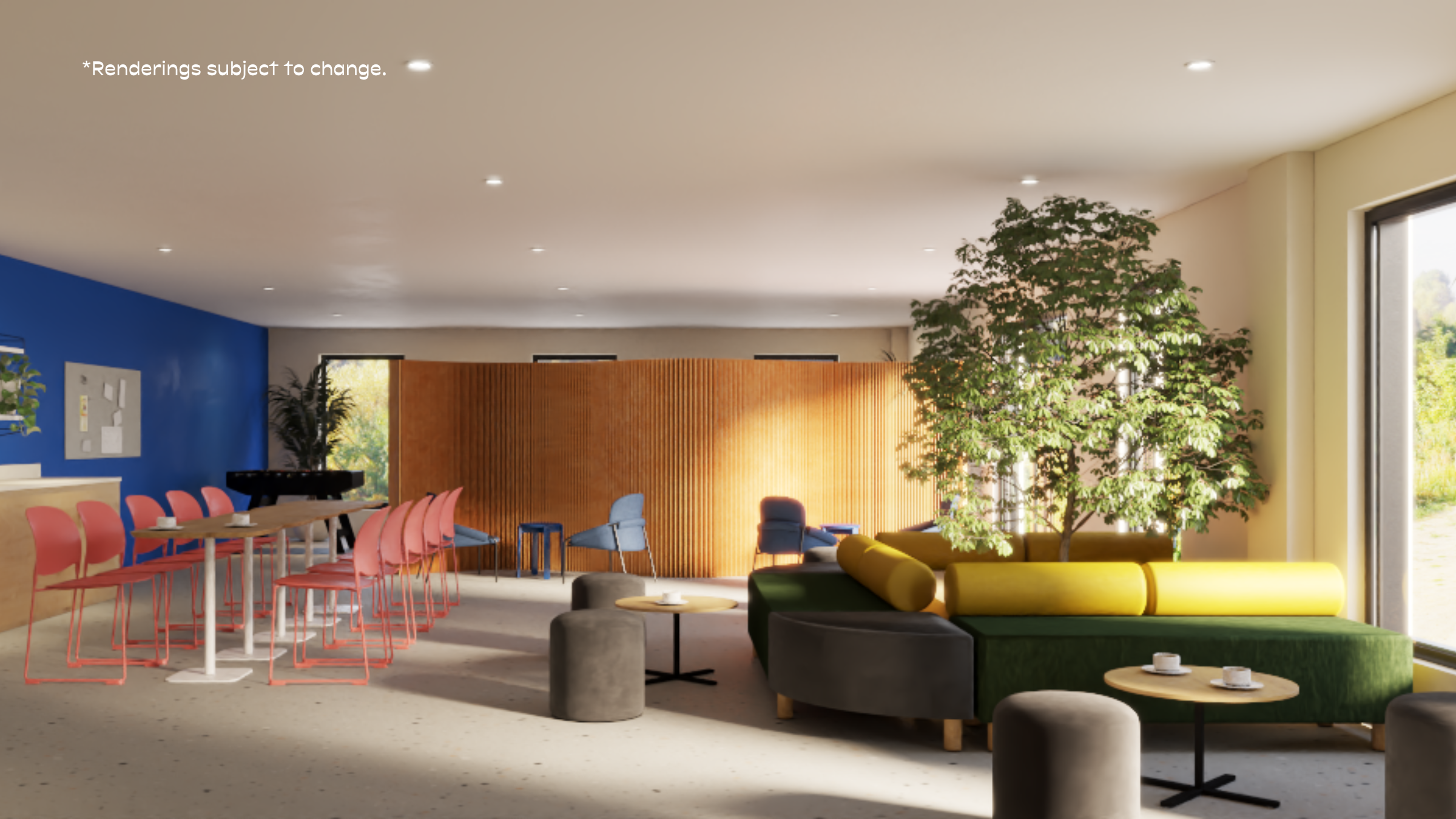
There’s a level of intimacy in simply existing alongside other people — being seen in the ordinary, without explanation. Student housing is built around that idea, whether you realize it or not. Communities like University Apartments are intentionally designed around shared spaces and everyday overlap, allowing connection to happen naturally, without pressure.
I’ve spent time in two University Apartments communities, and what I appreciated most was how differently coexistence showed up in each. At Wester-Land, shared amenity spaces like the games room made connection feel almost inevitable — watching people meet for the first time felt a lot like watching my own early university experience. At Palay, it’s quieter: quick elevator, small talk, familiar faces, and a sense that sharing a building makes people more open, even in brief moments. That everyday overlap is what makes connection feel natural, not forced.
You don’t have to try to build community when the environment is already doing some of that work for you. Living at University Apartments means having access to programming designed to make connection easier — art initiatives, local parties with live bands, free yoga, and mental health support through partners like MUN Minds. These aren’t just activities; they’re low-pressure ways to be around people without having to force conversation. Sometimes the hardest part of building community is simply finding the entry point. When those opportunities are already there, connection feels a lot more possible.
Community Doesn’t Have to Look One Way
That said, proximity isn’t the only way community forms — and if you’re looking for something more structured, those options exist too.
Student clubs and organizations bring people together around shared interests rather than shared spaces. Clubs are one of the best ways to do this. Regardless of the school you’re attending, McGill and Concordia both offer a wide range of student clubs and associations.
I’ll be honest — I never joined a club.
Post-grad, do I regret that? Of course. Not just because of the networks you build, but because clubs offer a sense of community that doesn’t always revolve around social routines or drinking. That perspective is something I didn’t fully experience.
But I don’t regret my university experience — not even a little.
My community formed in a much less intentional way. I met one of my closest friends by walking the wrong way to Econ 111. We had a terrible professor. I hated Econ. I asked him for notes. Four years later, we’re a group of six — who’ve traveled together and still end up at Cactus Club for happy hour most weekends.
If going out isn’t your thing — or you’re later in undergrad and craving something different — social clubs can be a great alternative. In Montréal, pages like What’s Up Montréal, Visit Montréal, and TheLilacdo a lot of the work for you by curating group activities and events. There are also book clubs, run clubs, and creative spaces like canvas clubs that offer connection without the pressure of nightlife. Being social in new ways often leads you to people you’d never normally meet — and some of those end up becoming the most meaningful connections.
Sometimes community comes from structure. Sometimes it happens by accident. And sometimes it forms quietly, without you realizing it’s happening at all.
Final Thoughts
Leaving student housing made me realize how much I took for granted.
Now, in a new city, starting over, there are moments where the excitement gives way to quiet and the “what have I done?” thought creeps in. And in those moments, it’s not independence I crave — it’s proximity. Someone nearby. Someone around. Someone to ask, “how was your day?”
Spaces that soften the landing matter. Student housing — including communities like Palay and University Apartments — isn’t just about convenience or location. It’s about everyday connection, even when you don’t realize you’re building it.
So if you’re questioning why you’re still there, or wondering when you’re supposed to “move on,” it might be worth rethinking what student housing actually offers. Because sometimes, it gives you more than you realize — until it’s gone.
When was the last time someone noticed if you came home?
When I first thought about budgeting, all I could picture were limitations, restrictions… handcuffs, honestly.
Who has time to think about money when you have class till 10 p.m.?
Learning how to manage your finances can feel overwhelming — especially if no one ever really taught you how to feel comfortable checking your bank account in the first place. Gaining independence sounds exciting, but it also comes with moments of discomfort, confusion, and yes… sometimes embarrassment.
These are a few things I started doing in university that helped me feel more in control of my money — without sucking the fun out of student life.
Get Comfortable Looking at Your Bank Account
We all know it’s easier to tap your card than it is to open your banking app and look at what’s actually inside.
But both matter.
If the thought of scrolling through past transactions makes you anxious, you’re not alone. I’ve been there. Independence comes with a learning curve, and sometimes that includes realizing you spent $50 at cafés in one week without even noticing.
And that realization can sting.
The goal isn’t to judge yourself — it’s to build awareness. Knowing how your money moves is the first step to managing it properly.
If this is your first time budgeting and you don’t know where to start, don’t overcomplicate it. Using a free, pre-built budgeting template — like the ones offered by Microsoft Excel — can make the process way less intimidating. You’re not starting from a blank page, and as a bonus, you’ll get more comfortable using Excel.
If you’re more of a listener than a spreadsheet person, podcasts can be an easy entry point. Young Money with Tracey Bissett is made specifically for students, new grads, and young professionals trying to get a grip on real-world finances. It breaks down budgeting, investing basics, and entrepreneurship in a way that actually makes sense — no guilt, no shame, just practical advice you can apply right away.
If you’re a McGill student, the Financial Literacy Centre is a great resource. Talking about money can feel intimidating, but these centres exist to support students — not judge them. Learning how your money works for you makes everything else feel less scary.
“We Have Food at Home”
Speaking of that $50 coffee habit…
Small purchases like coffee runs, food delivery, subscriptions, and sweet treats add up faster than we realize. And listen — I am fully on board with ending the shame around ordering Uber Eats.
But every second day? That may be a sign you have a slight problem…
This is hard to admit, but Uber Eats was the death of me in university. Not because I didn’t know how to cook — I was just lazy (lol). Waiting in the doorway while the driver called out “Bobby?” with a bag of Taco Bell for five people was humbling, to say the least.
The same goes for subscriptions. Beyond the obvious ones — Netflix, Prime, Disney+, Crave — there’s also ChatGPT, Notion, Canva, Apple Music (or Spotify, depending). You will never fully escape subscription life, but you can decide which ones actually add value to your academic and personal routine.
While writing this, I found an article from Maclean’s really helpful. It breaks down what students are actually spending their money on, and seeing those patterns laid out is oddly grounding. Maybe you relate — maybe you don’t — but at least now you know. And knowing is kind of the whole point.
The top 5 things I spent my money on in University:
Food — groceries + a lot of Uber Eats.
Social life — cactus club happy hour (I miss you).
Clothes — no explanation…
Books & academic materials — an unfortunate must.
Subscriptions & small conveniences — Apple Music student plan, Uber One, and other “it’s only $5” expenses.
Honourable mention: the gym. I didn’t spend extra on the gym because yoga and gym access were included in my student fees — one of the few line items I actually used (and loved). A good reminder that you’re paying for more than you think… whether you use it or not.
A tip that applies to both eating out and subscription overload: student discounts.
I took full advantage of Uber One for students and the Apple Music student plan. Sometimes it feels like a workaround to get the discount — but come on, you’re getting a degree. You can figure it out.
FOMO Is Real (But It Doesn’t Run Your Life)
Okay — maybe this is a bit of a fib. FOMO definitely exists.
But it doesn’t have to dictate your spending.
You don’t have to go out every weekend. And you definitely don’t have to go out every day of the weekend (there are only two — let’s relax).
There is absolutely no shame in staying in. Student housing communities like Palay make that easier by offering shared amenity spaces you already have access to — movie rooms, gyms, outdoor spaces, and study rooms. When I lived at Palay, I took advantage of the amenities (especially the movie room). It also made me realize how many of University Apartments communities across different cities offer the same kind of benefits — and how underrated that actually is.
Are these spaces always as aesthetic as the new café you keep seeing on TikTok that you need to study at? Maybe not.
But they are free.
Well… kind of.
But girl math applies.
Social media has a way of making it seem like everyone else is doing more, spending more, and living louder than you are. But social media isn’t real life.
So go watch a movie in the movie room. I won’t tell if you won’t.
The Bigger Picture
Managing your money in university is really about understanding — and accepting — that you won’t be able to do everything you want to do right away.
And that’s okay.
You’re not behind. You’re not failing. You’re exactly where you’re supposed to be. University is an investment in your future, and sometimes that means making short-term sacrifices so long-term goals are possible.
That’s what your twenties are for — learning, adjusting, and figuring it out as you go.
Resetting your relationship with money doesn’t mean restriction. It means awareness, balance, and choosing what actually supports your life right now.
See you next week, Liv
“New year, new you” is funny — mostly because we all say it every year and secretly know how that usually goes.
Still, whether you fully buy into resolutions or not, there’s something about January that naturally feels like a reset. The crisp air, the quieter routines, the sense that you could do things a little differently this time around.
For students, though, that reset can feel rushed. Winter break ends, classes start immediately, and before you know it, you’re back in the same habits you swore you were leaving behind. There’s rarely a clean slate — just a continuation.
So, from someone who’s been there, here are three realistic ways to actually reset as a university student, without turning it into another overwhelming goal you abandon by February.
1. Good Eats (The Kind That Actually Fuel You)
Just because something is fast doesn’t mean it’s good for you. Easy in the moment almost always becomes harder in the long run — especially when it comes to food.
Instead of aiming for perfection, focus on meals that work for your schedule and energy levels. One of the simplest shifts you can make is cooking meals that last more than one serving.
Your mom wasn’t cooking something different every night just for fun — she was feeding more than one person. As a student, cooking every single day is tough. Your time is limited, your budget is limited, and let’s be honest… so are your cooking skills.
This is where leftovers become your best friend.
A few go-to meals got me through university because they were low effort, flexible, and freezer-friendly:
Minimal ingredients, easy substitutions, and no stress when you don’t feel like cooking after a long day. Fueling yourself properly is one of the most underrated forms of self-care — and it doesn’t need to be complicated.
2. Reset Your Space, Reset Your Mind
The “Sunday reset” didn’t become a trend by accident. A clean space really does support a clearer mind.
After a long day of classes, the last thing you want is to come home to a small space that feels even smaller because of clutter. You’re grown now — your space matters.
I learned this early on when I was somehow the only one in my dorm who brought actual cleaning essentials. That may have been my mistake, because I quickly became the “mom” of the group — but every move-in day, I’d still make a quick Dollarama run to grab a few forgotten items and stock up on cleaning supplies. Keeping it simple and affordable made it easier to stay on top of mess before it became overwhelming.
Almost everything I used came from the dollar store. Cleaning isn’t exactly a student’s favorite activity, and spending money on cleaning supplies ranks even lower — keeping it budget-friendly makes it way more likely you’ll actually use them.
Studies consistently show that cluttered environments increase stress and decrease focus — and in university, focus is already in short supply.
Here’s the reset challenge: it takes roughly 21 days to start forming a habit. From now until the end of the month, use the remaining Sundays in January as true reset days. Not just laundry — but tidying, organizing, and setting yourself up for the week ahead.
Depending on who you ask, the week really does start on Sunday. Try it and notice how the rest of your week changes — not just in productivity, but in how you feel moving through it.
Taking pride in where you live is rewarding at any age, but it feels especially meaningful when you’re building independence for the first time.
Lately, my current obsession has been watching apartment cleaning videos — specifically Jimmy Wang’s“free therapy ”cleanings. Watching someone speed-clean a beautiful space instantly puts me in the mindset to do the same. I convince myself I can clean just as fast as the x2 version, and honestly? Sometimes it feels like they’ve already cleaned my apartment for me.
3. Where You Rest Your Head Actually Matters
Getting a degree isn’t just about studying and passing exams. It also depends heavily on your mental health — and in university, mental health is closely tied to your living environment.
Who you live with, where you live, and how supported you feel at home all play a role in your day-to-day well-being.
That’s why trusted student housing communities like Palay exist. Living in a space designed specifically for students means reliability, consistency, and being surrounded by people who are navigating the same stage of life as you.
Many student housing communities, including Palay, also offer shared amenities like gyms, study rooms, and movie spaces — areas that support your mental health outside of your apartment and encourage balance beyond academics.
If you find yourself re-evaluating where you live mid-semester, that feeling isn’t random. Choosing a space that supports your routine, your rest, and your reset can make a noticeable difference in how the semester unfolds.
Most resolutions are dropped by February — but if you start in the middle of January, does that still count?
Absolutely.
Bettering yourself doesn’t follow a timeline, and resetting doesn’t have to be dramatic. These are just a few small, realistic shifts from someone who’s been where you are — to help make your winter semester feel a little more manageable than the last.
See you next week
Liv
Your Own Room, Shared Common Spaces Going to school in MTL but don’t have roommates yet? We’ve got you covered.
At Palay, you can lease a private bedroom in one of our fully furnished units – just steps from McGill and Concordia in the heart of downtown. We’ll set you up with roomies, or help you find your own! All you need to do is relax.
Your private bedroom comes with everything you need to feel at home, while shared spaces are perfect for group hangouts, movie nights, or quiet study sessions.
THE DETAILS
Your private bedroom
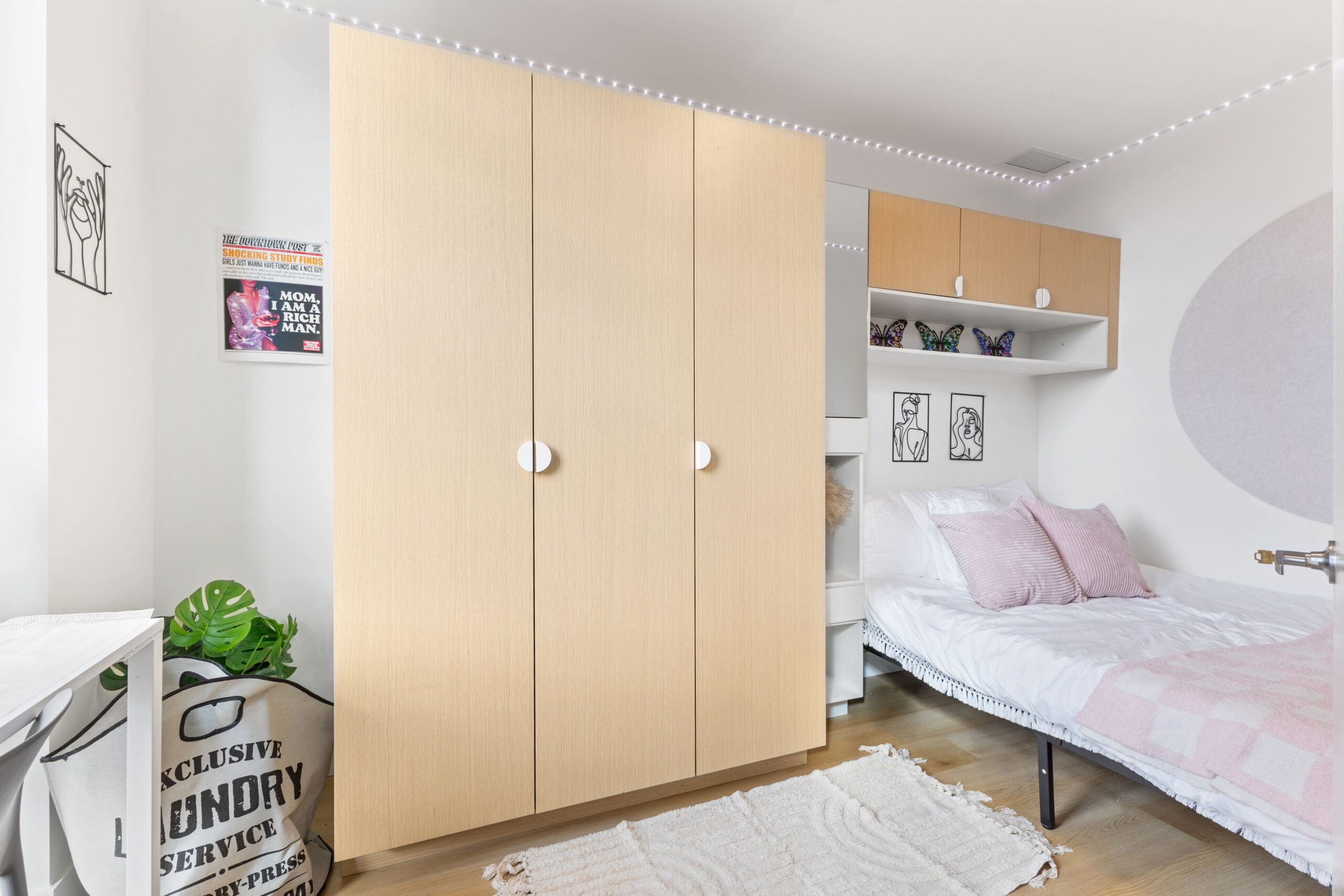
🛏️ A double bed with enough room to store your luggage underneath
💡 An open shelf above the bed
📚 Cabinets (large enough to fit books and anything else you may need) above the bed for extra storage
📌 Multi-purpose cork board that doubles as soundproofing
👚 An armoire for clothing, shoes and other storage
🖤 Black out curtains
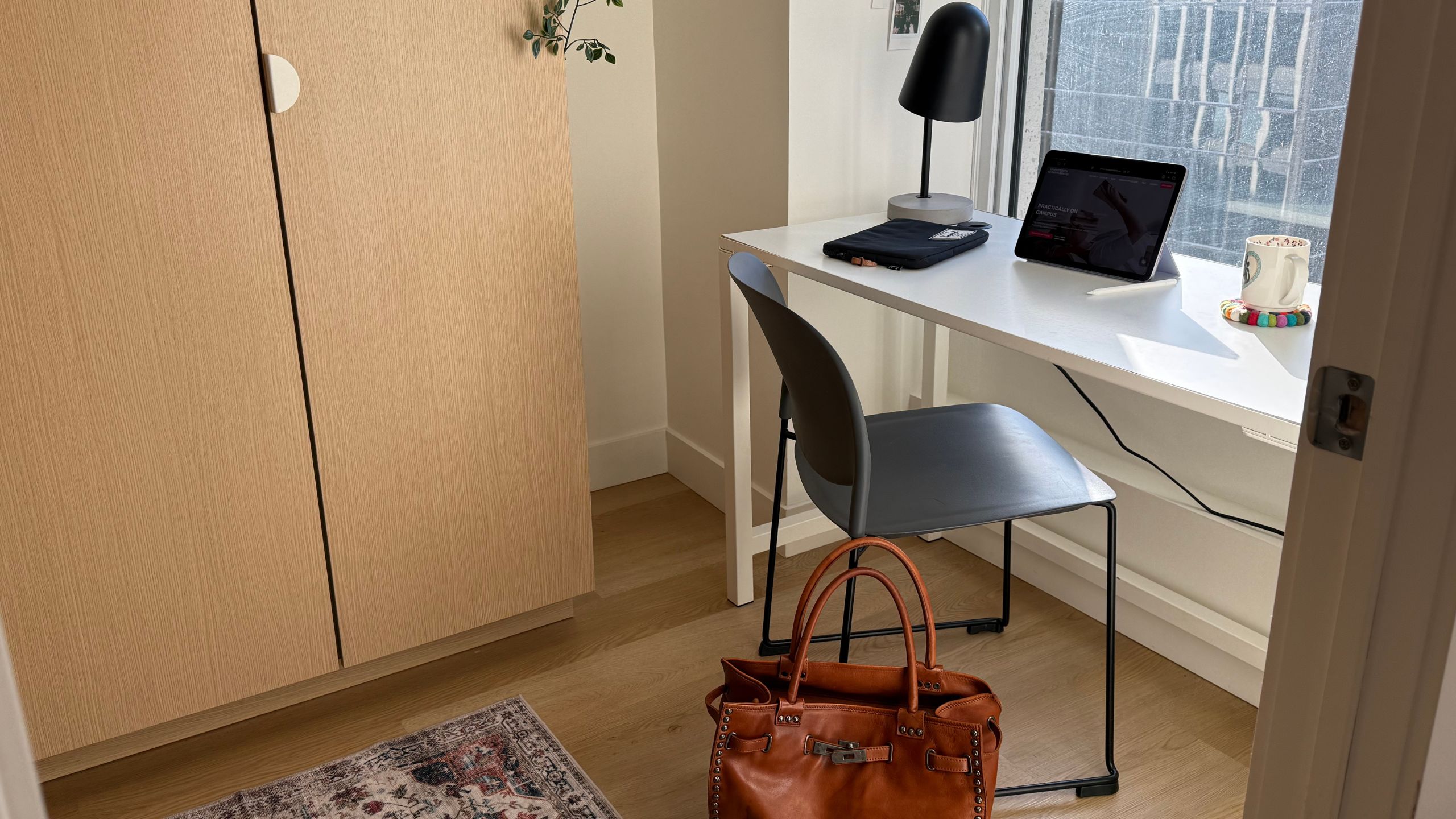
🪑 A study nook fully equipped with a desk and chair
🎒 Hooks for bags and any stuff you need to grab and go!
Shared Bathrooms
🛀 1 bathroom
💊 A vanity with spacious drawers
🌟 A mirror so you can get ready in style
🧻 Extra storage for bathroom items, ‘cos nobody wants to run outta TP…
Shared Kitchen
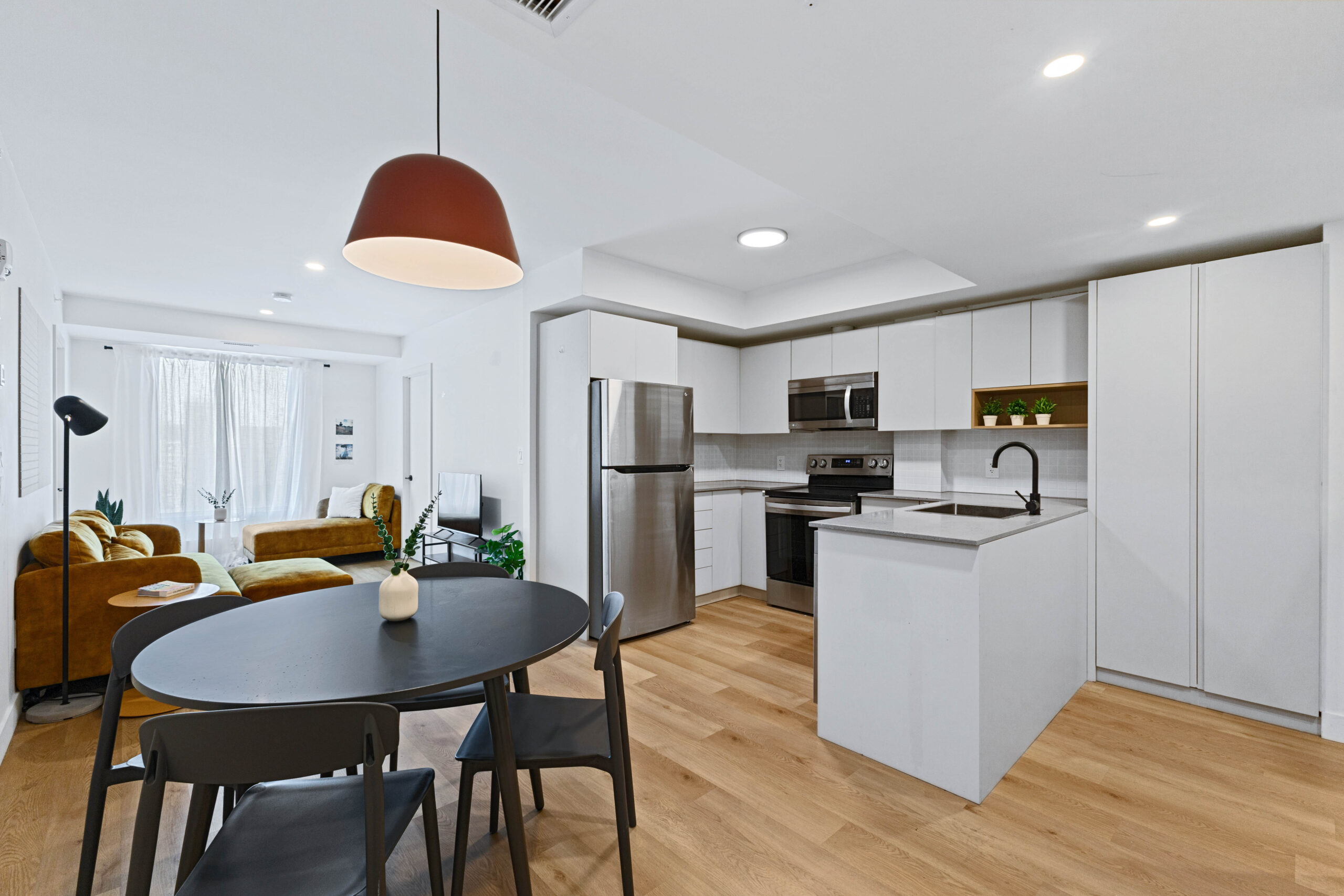
💎 Stainless steel appliances, including a fridge, stove, microwave AND dishwasher
🔪 Tons of counter space, perfect for cooking by yourself or with your roomies
🍽️ Lots of cabinet space for storing kitchenware
Shared Living room
🛋️ A cozy couch, ottoman and chaise lounge
📺 A TV stand
💻 Laptop table(s) with easy stoaway
🍺 A dining area with a table and chairs for communal meals, studying, or just hanging out…
BUILDING AMENITIES
👟 Gym
📽️ Theater room
🌳 Outdoor oasis space
📚 Common study room
🧺 Laundry rooms – coin operated
🍳 Brand new stainless steel kitchen appliances (dishwasher incl.)
🛀 Bathrooms with shower AND bath
🚴 Bike parking in the basement
🧻 Lots of extra storage
🔒 Secure buzzer system at the front
📶 Wi-Fi
***Disclaimer: Features may differ from how they appear on our website. Furniture items may vary.
This 3 bedroom, 1 bathroom is the perfect spot for students attending McGill or Concordia in Montreal. This unit is fully furnished, practically on campus, and home to a variety of on-site amenities, making it the perfect spot to accommodate university student’s needs.
The airy common room comes furnished with a couch, stoway laptop tables, and TV stand, making it a perfect spot for communal activities or solo studying. The unit also includes a dining table with chairs, and a fully equipped kitchen with 5 appliances.
Each bedroom features a double bed, wardrobe, extra shelving and a study nook with a desk and chair.
THE DETAILS
Each bedroom
🛏️ A double bed with enough room to store your luggage underneath
💡 An open shelf above the bed
📚 Cabinets (large enough to fit books and anything else you may need) above the bed for extra storage
📌 Multi-purpose cork board that doubles as soundproofing
👚 An armoire for clothing, shoes and other storage
🖤 Black out curtains
🪑 A study nook fully equipped with a desk and chair
🎒 Hooks for bags and any stuff you need to grab and go!
Bathrooms
🛀 1 bathroom
💊 A vanity with spacious drawers
🌟 A mirror so you can get ready in style
🧻 Extra storage for bathroom items, ‘cos nobody wants to run outta TP…
Kitchen
💎 Stainless steel appliances, including a fridge, stove, microwave AND dishwasher
🔪 Tons of counter space, perfect for cooking by yourself or with your roomies
🍽️ Lots of cabinet space for storing kitchenware
Living room
🛋️ A cozy couch, ottoman and chaise lounge
📺 A TV stand
💻 Laptop table(s) with easy stoaway
🍺 A dining area with a table and chairs for communal meals, studying, or just hanging out…
BUILDING AMENITIES
👟 Gym
📽️ Theater room
🌳 Outdoor oasis space
📚 Common study room
🧺 Laundry rooms – coin operated
🍳 Brand new stainless steel kitchen appliances (dishwasher incl.)
🛀 Bathrooms with shower AND bath
🚴 Bike parking in the basement
🧻 Lots of extra storage
🔒 Secure buzzer system at the front
📶 Wi-Fi
***Disclaimer: Features may differ from how they appear on our website. Furniture items may vary.